🐾Pawbiotics

Dogs

Dog Bloat (GDV): Early Warning Signs, Causes, and Emergency Action Plan

Published 2026-08-309 min read

Canine bloat, clinically known as Gastric Dilatation-Volvulus (GDV), is one of the most sudden and fatal veterinary emergencies a pet parent can face. When GDV occurs, the dog's stomach fills rapidly with gas, food, or fluid, and then rotates on its axis. This cuts off blood flow to vital abdominal organs and sends the cardiovascular system into catastrophic shock within hours. Recognizing the earliest warning signs and acting immediately is essential for survival.

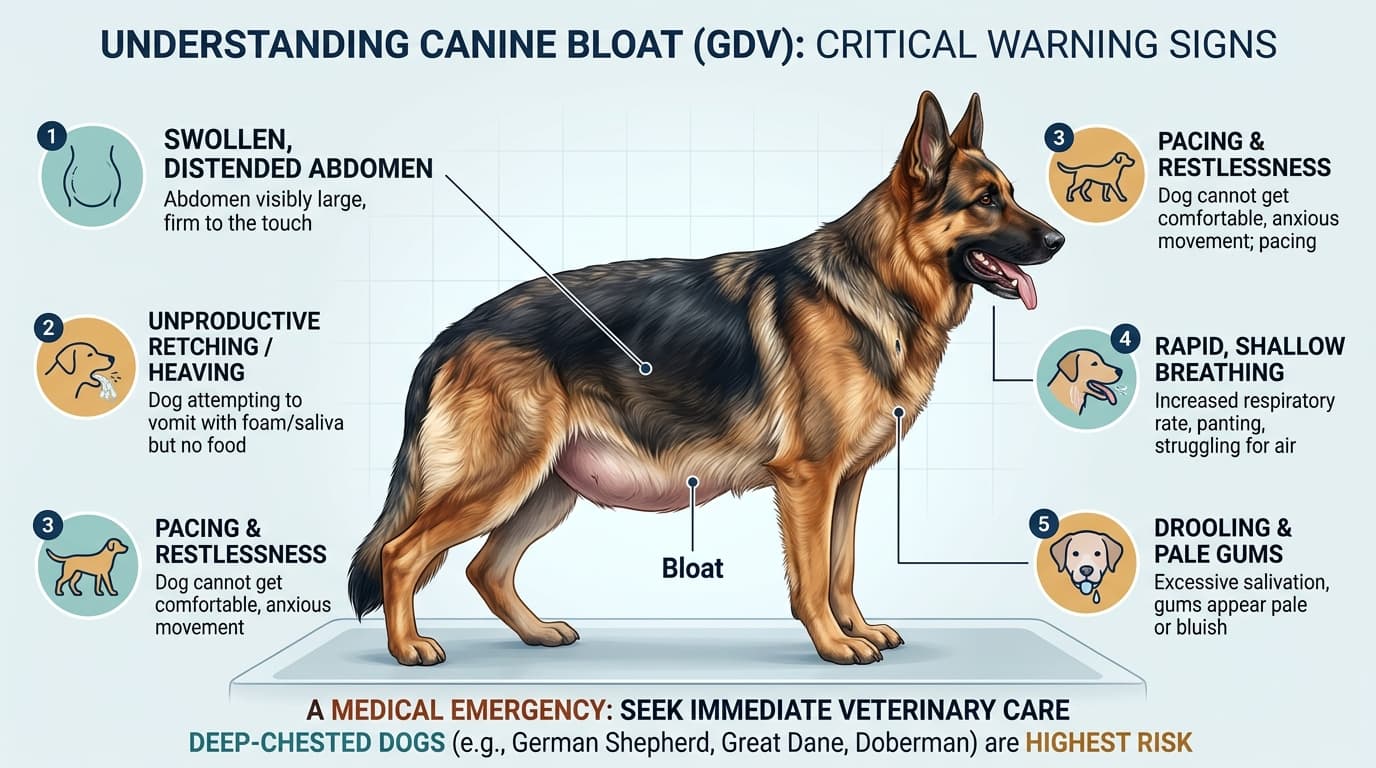
Canine Bloat (GDV) Warning Signs Infographic in Dogs
Critical clinical signs of canine bloat (GDV): abdominal distension, unproductive retching, pacing restlessness, and rapid shallow breathing.
Educational guide only. This article does not replace a veterinary exam, diagnosis, or emergency care.

Quick Summary: What Every Dog Owner Needs to Know About Bloat (GDV)

Canine bloat is a true medical emergency with a mortality rate exceeding 30% if left untreated. In deep-chested and large breed dogs, the stomach can rapidly distend and twist (volvulus), trapping gas and compromising major blood vessels including the caudal vena cava.

Every minute counts. Never wait to see if bloat symptoms improve overnight. If your dog exhibits the hallmark triad — unproductive retching (dry heaving), pacing restlessness, and a tight, swollen abdomen — transport them to the nearest 24/7 veterinary emergency hospital immediately.

Checklist

  • GDV is fatal without emergency veterinary decompression and surgical intervention.
  • The classic sign is non-productive retching: trying desperately to vomit but only producing white foam or thick saliva.
  • Large, deep-chested breeds (Great Danes, German Shepherds, Standard Poodles) have a lifetime risk of up to 40%.
  • Preventive gastropexy ('stomach tacking') performed during routine spay/neuter reduces GDV risk by over 90%.
What Is Bloat in Dogs vs. Gastric Dilatation-Volvulus (GDV)?

While dog owners commonly use the word 'bloat' interchangeably, veterinarians distinguish between two distinct conditions: Simple Gastric Dilatation and Gastric Dilatation-Volvulus (GDV).

Simple Gastric Dilatation occurs when the stomach becomes abnormally distended with gas, swallowed air (aerophagia), or fermented food, but has not yet rotated. While painful, it can sometimes be decompressed with a stomach tube.

Gastric Dilatation-Volvulus (GDV) occurs when the distended stomach twists between 90 and 360 degrees clockwise. This twists closed both the esophagus entrance (cardia) and the intestinal exit (pylorus), effectively sealing the stomach shut. The spleen, which shares blood vessels with the stomach, is dragged along and often suffers infarction. As intragastric pressure skyrockets, it compresses the vena cava, slashing cardiac output and precipitating life-threatening hypovolemic and obstructive shock.

Early Warning Signs: How to Recognize Bloat Symptoms in Dogs

Bloat progresses with terrifying speed. In many cases, a dog may appear completely normal at dinner and be in critical cardiovascular shock two hours later. Recognizing the earliest subtle behavioral shifts allows you to intervene before irreversible gastric necrosis occurs.

The most common early symptoms of bloat in dogs include:

Checklist

  • Unproductive Retching & Dry Heaving: The dog repeatedly hacks, gags, or tries to vomit every 2 to 5 minutes, but nothing comes up except small amounts of foamy white mucus or thick drool.
  • Pacing, Whining, & Severe Restlessness: Dogs cannot get comfortable, refuse to lie down, repeatedly stand up and pace, or sit in a hunched 'prayer position' with front paws down and rear elevated.
  • Abdominal Distension & Tightness: The belly behind the ribcage looks noticeably swollen, enlarged, or feels hard and drum-like (tympanic) when gently tapped.
  • Excessive Drooling & Hypersalivation: Profuse foamy saliva hanging from the jowls due to the inability to swallow fluids past the twisted esophagus.
  • Rapid, Shallow Panting: Increased respiratory effort because the massive stomach presses forward against the diaphragm, restricting lung expansion.
  • Pale or Gray Gums & Weakness: As blood pressure collapses, gums turn pale, grayish, or muddy white, followed by collapse or inability to stand.

Clinical Comparison: Simple Gas Bloat vs. True GDV Torsion

Differentiating between mild dietary gas indigestion and a life-threatening GDV emergency is crucial. When in doubt, always treat the situation as an emergency and seek immediate veterinary evaluation.

Clinical Feature

Onset Speed

Simple Dietary Gas / Mild Bloat

Gradual (over several hours after eating)

True GDV (Gastric Torsion Emergency)

Sudden & rapid (within 30 to 120 minutes)

Clinical Feature

Retching / Vomiting

Simple Dietary Gas / Mild Bloat

May produce food, bile, or burp gas

True GDV (Gastric Torsion Emergency)

Repeated unproductive dry heaving (foam only)

Clinical Feature

Abdominal Feel

Simple Dietary Gas / Mild Bloat

Slightly soft, mild distension, passes gas

True GDV (Gastric Torsion Emergency)

Extremely tight, swollen, hard drum-like feel

Clinical Feature

Behavior & Posture

Simple Dietary Gas / Mild Bloat

May lie quietly or sleep uncomfortably

True GDV (Gastric Torsion Emergency)

Frantic pacing, inability to lie down, hunched stance

Clinical Feature

Gum Color & CRT

Simple Dietary Gas / Mild Bloat

Healthy pink, capillary refill under 2 sec

True GDV (Gastric Torsion Emergency)

Pale, grayish, or muddy; refill time over 2-3 sec

Clinical Feature

Heart Rate & Shock

Simple Dietary Gas / Mild Bloat

Normal to mildly elevated heart rate

True GDV (Gastric Torsion Emergency)

Severe tachycardia (>160 bpm), weak pulse, collapse

Clinical Feature

Urgency Level

Simple Dietary Gas / Mild Bloat

Monitor closely; call vet for advice

True GDV (Gastric Torsion Emergency)

CRITICAL EMERGENCY: Transport to ER hospital NOW

High-Risk Breeds & Predisposing Factors

Any dog can develop bloat, but deep-chested, large, and giant breeds have an anatomical predisposition. The deep thoracic cavity allows greater pendulum movement of the stomach, making torsion significantly more likely.

Below are the breeds with the highest lifetime statistical incidence of GDV:

Dog Breed

Great Dane

Chest Conformation

Extremely deep, narrow thorax

Estimated Lifetime GDV Risk

~39% to 42%

Key Risk Notes

Highest risk of all dog breeds; prophylactic gastropexy strongly advised.

Dog Breed

Saint Bernard

Chest Conformation

Deep, broad chest

Estimated Lifetime GDV Risk

~21% to 24%

Key Risk Notes

High incidence linked to rapid eating and heavy body weight.

Dog Breed

Weimaraner

Chest Conformation

Deep, aerodynamic chest

Estimated Lifetime GDV Risk

~20% to 22%

Key Risk Notes

Prone to high anxiety, nervous temperament, and fast eating.

Dog Breed

Irish Setter

Chest Conformation

Deep, narrow chest

Estimated Lifetime GDV Risk

~18% to 20%

Key Risk Notes

High physical energy; active movement after large meals.

Dog Breed

Standard Poodle

Chest Conformation

Deep, narrow thorax

Estimated Lifetime GDV Risk

~15% to 18%

Key Risk Notes

Genetic predisposition; aerophagia during stressful events.

Dog Breed

German Shepherd

Chest Conformation

Deep chest, active drive

Estimated Lifetime GDV Risk

~15% to 17%

Key Risk Notes

Very common patient in emergency veterinary surgical suites.

Dog Breed

Doberman Pinscher

Chest Conformation

Deep, tight chest

Estimated Lifetime GDV Risk

~12% to 15%

Key Risk Notes

Often combined with underlying cardiac risks like DCM.

Dog Breed

Boxer

Chest Conformation

Deep, muscular chest

Estimated Lifetime GDV Risk

~10% to 12%

Key Risk Notes

Prone to rapid gulped eating and swallowing excessive air.

Checklist

  • Age: Dogs over 7 years old are more than twice as likely to develop GDV due to laxity in the hepatogastric ligaments.
  • Feeding Patterns: Eating a single massive meal per day or bolting food rapidly increases gastric volume and swallowed air.
  • Temperament: Fearful, anxious, or hyperactive dogs show significantly higher rates of bloat than relaxed dogs.
  • Genetics: Having a first-degree relative (parent or sibling) with a history of GDV increases a dog's risk by 63%.

Emergency Action Protocol: What to Do in the First 60 Minutes

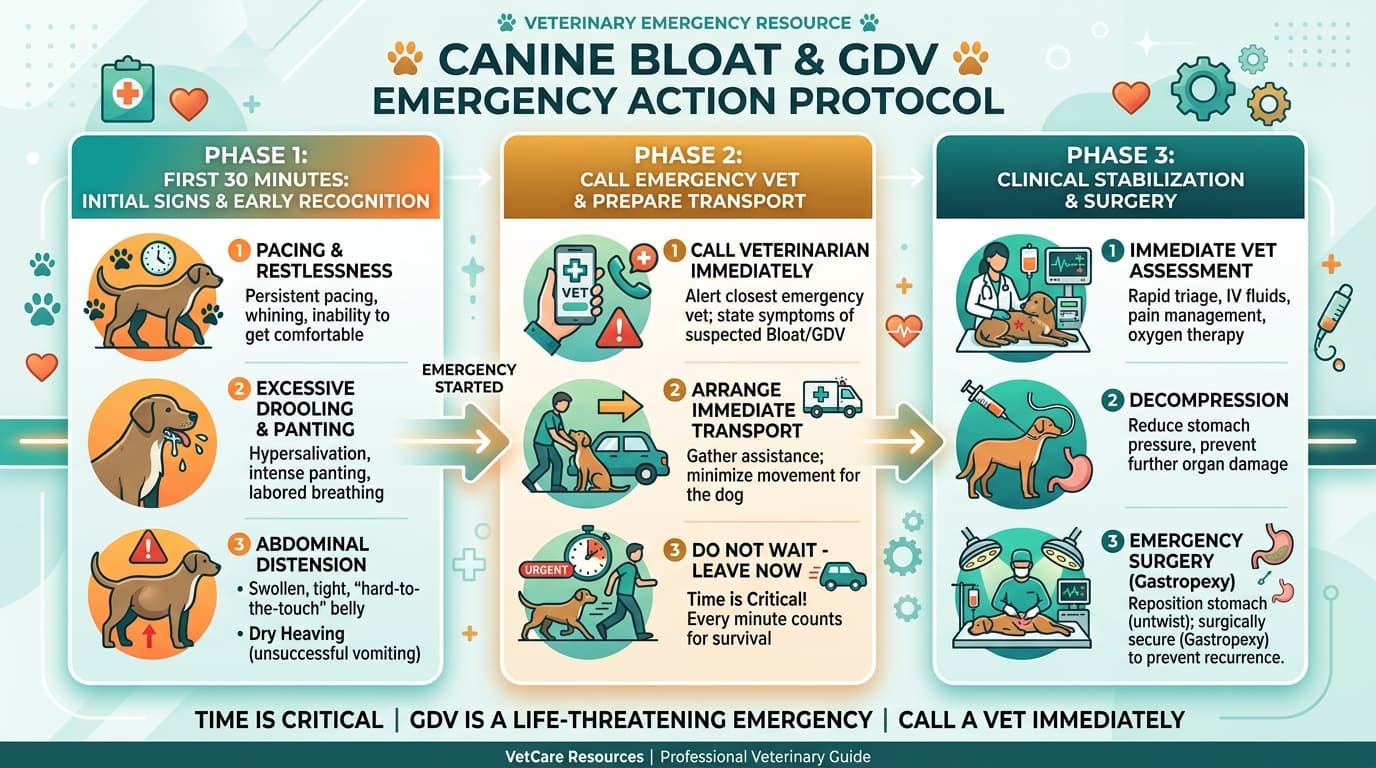
If you suspect your dog has bloat or GDV, every second matters. Follow this veterinary first-aid protocol immediately:

1. Call the Nearest Emergency Vet While En Route: Alert the triage team that you are arriving with a suspected GDV case so they can prepare oxygen, IV catheters, and emergency decompression equipment.

2. Do NOT Attempt Home Remedies: Never give water, food, milk, or home antacids. Do NOT try to induce vomiting with hydrogen peroxide — if the stomach is twisted, inducing vomiting will cause gastric rupture or aspiration pneumonia.

3. Transport with Minimal Handling: Keep the dog calm, support their chest and hindquarters evenly, and avoid pressing on the abdomen during lifting and transport.

4. Keep the Car Cool & Well-Ventilated: Ensure adequate airflow and calm lighting to minimize sympathetic nervous system stress during the drive.

Canine Bloat & GDV Emergency Action Protocol Timeline
Step-by-step emergency action timeline: from early symptom recognition in the first 30 minutes to immediate veterinary triage and surgical gastropexy.

Veterinary Treatment: Decompression, Surgery, and Gastropexy

Upon arrival at the emergency clinic, veterinary staff will perform rapid triage and life-saving stabilization:

Step 1: Emergency Shock Resuscitation: Placement of large-bore cephalic IV catheters to administer rapid isotonic fluid boluses and cardiovascular support medications, countering obstructive shock.

Step 2: Gastric Decompression: Passing an orogastric tube or performing percutaneous trocarization (inserting a large-gauge needle through the body wall directly into the stomach) to release trapped gas and relieve pressure on the vena cava.

Step 3: Abdominal Radiographs: Right lateral X-rays to confirm the classic 'Popeye arm' or 'double bubble' sign indicating true gastric volvulus.

Step 4: Emergency Exploratory Surgery: The surgeon inspects the stomach and spleen, untwists the stomach into its normal anatomical position, resects any devitalized necrotic tissue (partial gastrectomy or splenectomy if needed), and performs a Gastropexy.

A Gastropexy permanently anchors the outer muscular layer of the stomach (antrum) to the right internal abdominal wall. While it does not prevent gas accumulation, it prevents the stomach from ever twisting again, reducing recurrence rates from 80% down to under 3%.

Proven Prevention Strategies: Reducing Bloat Risk at Home

While you cannot change your dog's breed or genetics, veterinary nutritionists recommend several evidence-backed feeding practices to dramatically reduce bloat risk:

1. Divide Daily Calories into 2 to 3 Smaller Meals: Never feed a single large daily portion. Use our free Dog Food Calculator to determine exact daily caloric needs and split them into balanced, manageable servings.

2. Slow Down Fast Eaters: Utilize maze slow-feeder bowls, puzzle toys, or muffin tins with tennis balls to prevent dogs from inhaling kibble and gulping excessive air (aerophagia).

3. Enforce a 60-Minute Rest Period: Avoid vigorous running, ball fetching, or intense exercise 1 hour before and at least 1 to 2 hours after meals.

4. Reconsider Elevated Feeders for High-Risk Breeds: Large-scale veterinary studies (such as the Purdue University GDV Study) found that elevated feeding stands actually increased GDV risk in giant breeds by up to 110%. Feed high-risk dogs at floor level unless instructed otherwise for megaesophagus.

5. Support Gut Microbiome & Motility: Healthy intestinal microflora promotes smooth gastric emptying and reduces abnormal microbial gas fermentation. Consider pairing regular nutrition with a species-specific probiotic blend — check our Dog Probiotic Calculator to determine optimal CFU dosing.

6. Consider Prophylactic Gastropexy: For high-risk breeds like Great Danes or German Shepherds, speak to your veterinarian about performing a laparoscopic or open prophylactic gastropexy at the time of spay or neuter.

Frequently Asked Questions

Without veterinary treatment, true Gastric Dilatation-Volvulus (GDV) can prove fatal in as little as 1 to 2 hours. The twisted stomach compresses the vena cava, slashing blood return to the heart, causing cardiac arrhythmias, tissue necrosis, and fatal endotoxic shock.

The abdomen behind the ribcage often appears visibly swollen, taut, and enlarged, particularly on the left side. When gently tapped with your fingers, it may feel hard and sound hollow like a drum (tympanic). However, in deep-chested breeds, the stomach may expand inward beneath the ribcage with minimal obvious external swelling.

If the stomach has twisted (true GDV), surgery is mandatory. Simple dilatation without rotation can sometimes be relieved with tube decompression and medical management, but recurrence rates without surgical gastropexy exceed 80%.

Bloat involves rapid gas distension and potential twisting of the stomach itself. Intestinal obstruction involves a physical blockage (such as a toy, bone, or foreign body) stuck in the small or large intestine. Both require urgent veterinary imaging, but GDV progresses much more rapidly to cardiovascular collapse.

No. True GDV cannot resolve on its own. It is a mechanical obstruction and vascular strangulation that requires urgent professional decompression and surgical repositioning.

Emergency GDV surgery, hospitalization, IV shock therapy, diagnostics, and gastropexy typically range from $3,000 to $8,000+ depending on whether partial gastrectomy or splenectomy is required and the geographic region.

Purdue University epidemiological studies demonstrated that feeding large and giant breed dogs from elevated bowls significantly increased the risk of GDV. Most veterinary surgeons now recommend feeding high-risk deep-chested dogs from floor level.

A prophylactic gastropexy is a preventive surgical procedure where the stomach is permanently tacked to the abdominal wall, typically performed during a routine spay or neuter. While the dog can still experience gas bloat, the stomach can never rotate into fatal torsion.