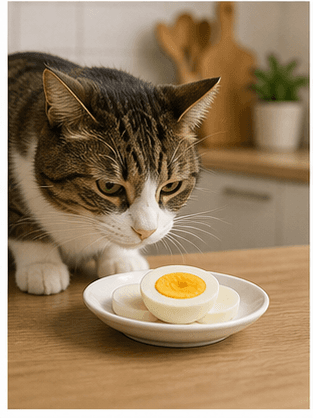
Quick answer: can cats eat eggs?
What this means
Yes, many healthy cats can eat a tiny amount of plain cooked egg. Eggs should be fully cooked, unseasoned, and treated as an occasional treat, not a meal replacement.
Cats
Published 2026-05-03 • 9 min read
Eggs can be safe for some healthy cats in tiny cooked portions, but they are not needed for a balanced feline diet. This guide explains how to avoid common mistakes.

Yes, many healthy cats can eat a tiny amount of plain cooked egg. Eggs should be fully cooked, unseasoned, and treated as an occasional treat, not a meal replacement.
Ask your vet first if your cat has pancreatitis risk, obesity, diabetes, food allergies, kidney disease, digestive sensitivity, or a prescription diet.
Cooked eggs are safer than raw eggs because raw eggs can carry bacteria and create avoidable food-safety risk. Do not add butter, salt, onion, garlic, cheese, or spices.
Portions should be tiny. Start with a pea-sized amount and monitor stool, appetite, and vomiting for the next day.
Eggs are not ideal for every cat.
Eggs can cause problems when portions or preparation are wrong.
Call if your cat vomits repeatedly, has diarrhea, stops eating, seems weak, develops swelling or itch, or reacts after any new food.
Eggs are optional.
Yes, some cats can eat a tiny amount of plain scrambled egg with no butter, oil, salt, cheese, onion, or garlic.
Plain boiled egg can be safe in tiny portions for many healthy cats. Keep it rare and small.
Raw eggs are not recommended because of bacterial risk and avoidable food-safety concerns.
Kittens should focus on complete kitten food. Egg treats are unnecessary and may upset digestion.
Do not use eggs as a diarrhea treatment. New foods or extra fat may worsen stomach upset.
Read [cats that puke](/blog/cats-that-puke) and [cat gut health guide](/blog/cat-gut-health-guide).