🐾Pawbiotics

Health Conditions

What Do Axolotls Eat? A Complete Feeding Guide

Published 2026-05-0110 min read

Axolotls are fascinating — permanently larval salamanders that spend their entire lives underwater. Their feeding needs are specific and often misunderstood. Feed them the wrong food and they'll refuse to eat. Feed them too much and you'll foul the water. This guide covers everything you need to get it right.

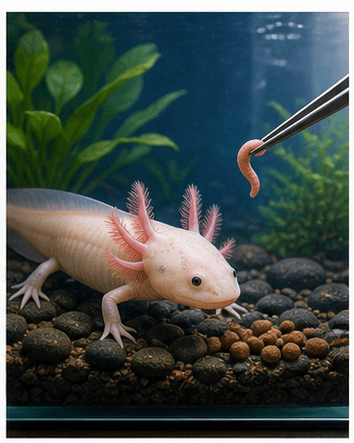
Axolotl in a clean aquarium with safe feeding foods nearby
Axolotls need appropriately sized protein foods and stable water quality to feed well.
Educational guide only. This article does not replace a veterinary exam, diagnosis, or emergency care.

What Do Axolotls Eat in the Wild?

In the wild, axolotls live in Mexico's Lake Xochimilco and its connected canals. They're carnivorous predators.

Wild axolotls eat:

They hunt using suction feeding — they create a rapid vacuum with their mouths and inhale prey whole. Their teeth are small and not built for tearing.

This is critical for captive feeding: food needs to be an appropriate swallowable size.

Checklist

  • Small fish and fish fry
  • Worms — earthworms, bloodworms, tubifex worms
  • Aquatic insects and larvae
  • Small crustaceans
  • Mollusks — snails and small shellfish
  • Tadpoles and small amphibians

What to Feed Axolotls in Captivity

1. Earthworms — The Best Staple Food

Earthworms (nightcrawlers) are widely considered the best primary food for captive axolotls.

They're nutritionally complete. High in protein. Easy to find in bait shops or online. Soft enough to digest easily.

Cut them to an appropriate size — roughly equal to the width of the axolotl's head. Adults can handle larger pieces or full worms. Juveniles need small segments.

Avoid worms from your garden unless you're certain they haven't been exposed to pesticides.

2. Bloodworms

Bloodworms (frozen or freeze-dried) are a popular supplement, especially for younger axolotls.

They're high in protein and trigger a strong feeding response. However, they're not nutritionally complete enough to be the sole diet.

Use frozen bloodworms over freeze-dried when possible — they retain more nutritional value and are easier to digest.

3. Axolotl Pellets

High-quality sinking pellets designed for axolotls (or large carnivorous fish like salmon) make feeding easy and mess-free.

Look for pellets with 40%+ protein from animal sources. Repashy Grub Pie and NLS Thera+A are popular with axolotl keepers.

Pellets sink immediately — important because axolotls are bottom dwellers. Floating food is largely ignored.

4. Blackworms

Live blackworms are an excellent high-protein food. They can be kept alive in cold water in the fridge for weeks.

Many axolotl keepers use blackworms as a daily staple because they stay alive in the tank, triggering the axolotl's natural hunting response.

5. Brine Shrimp

Good for juvenile and baby axolotls. Adults need larger prey to feel satisfied.

Use as a supplement, not a staple. Nutritional value is lower than earthworms or pellets.

6. Feeder Fish — Use Caution

Feeder guppies or goldfish are sometimes used but come with significant risks:

If using feeder fish, quarantine them first and avoid goldfish entirely.

Checklist

  • Goldfish carry parasites that can infect axolotls
  • Feeder fish from pet stores often carry diseases
  • Small fish bones can cause impaction

What Axolotls Should NOT Eat

Checklist

  • Red wigglers (red worms) — contain compounds that can be toxic to axolotls
  • Superworms and mealworms — tough chitin exoskeleton is hard to digest
  • Processed human food
  • Beef heart or chicken — too fatty, poor long-term nutrition
  • Waxworms — too high in fat for regular feeding
  • Any food larger than the axolotl's head width — impaction risk

Feeding by Age

Baby Axolotls (Under 3 cm)

Baby axolotls are difficult to feed. They need live food that moves and triggers their hunting instinct.

Best options: baby brine shrimp, micro worms, daphnia. Feed twice daily.

Juvenile Axolotls (3–10 cm)

At this stage, small bloodworm portions, earthworm segments, and small pellets all work well.

Feed daily or every other day.

Adult Axolotls (10 cm+)

Adults can eat full-sized earthworms, nightcrawlers, large pellets, and blackworms.

Feed every 2–3 days. Overfeeding pollutes the tank and leads to obesity.

Feeding Tips

❓ Frequently Asked Questions

Checklist

  • Feed at night or dim the lights — axolotls are crepuscular and more active in low light
  • Use feeding tongs or tweezers to offer worms — reduces accidental gravel ingestion
  • Remove uneaten food within 20–30 minutes to protect water quality
  • Fast for 1 day per week — gives the digestive system time to clear
  • Never tap the glass to make them eat — stress reduces appetite

Frequently Asked Questions

Adults: every 2–3 days. Juveniles: daily or every other day. Baby axolotls: twice daily with live food. Remove all uneaten food within 30 minutes.

Yes. Frozen bloodworms and frozen brine shrimp are both good options. Thaw in tank water before feeding. Never feed directly from frozen.

Common reasons: water temperature too warm (axolotls prefer 60–68°F), stress from poor water quality, recent handling, or tank mates. New axolotls often take 1–2 weeks to settle in and begin eating.

High-quality sinking pellets can form the backbone of the diet, but variety is better. Rotate with earthworms and occasional blackworms for nutritional completeness.

No. Axolotls are obligate carnivores. They do not eat plant matter. Live plants in the tank are for enrichment and water quality — not food.