Takeaway 1
Urinary blockage is a critical 24-48 hour life-threatening emergency
Pet Health Guide
A urinary blockage in cats is a life-threatening veterinary emergency affecting mostly male cats. When a cat cannot urinate due to crystalline plugs or spasms, toxins build up within hours. Immediate emergency care is required.
Educational only. Always consult a licensed veterinarian for diagnosis or treatment.
Quick Answer
Yes, if your cat is repeatedly straining in the litter box, crying in pain, or producing zero urine, this is an immediate medical emergency. Fatal cardiac arrest and acute kidney failure can occur in 24 to 48 hours. Transport your cat to an emergency veterinarian immediately.
Urethral blockage is a rapidly fatal condition causing toxic potassium accumulation (hyperkalemia) and cardiac arrest. If zero urine is coming out, transport to emergency care immediately.
Key clinical signs distinguishing a life-threatening blocked cat from non-obstructive bladder issues.
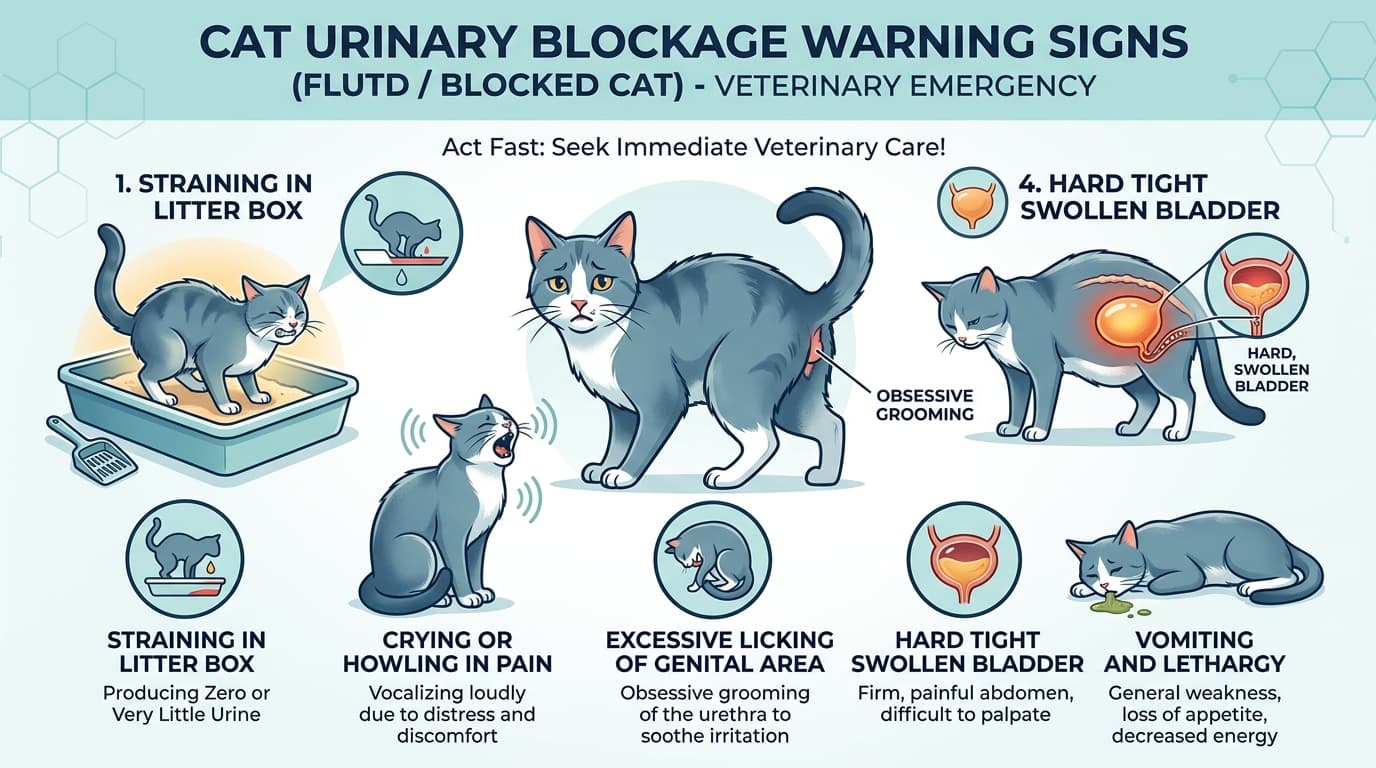
Use this veterinary comparison matrix to assess urgency when your cat is posturing in the litter box:
| Clinical Indicator | Non-Blocked Cystitis (FIC) | Complete Blockage (Blocked Cat) | Constipation / Megacolon |
|---|---|---|---|
| Urine Output | Frequent small puddles (dimes/quarters) | ZERO urine produced despite straining | Normal urination; zero feces |
| Bladder Palpation | Small, soft, non-distended | Rock-hard, swollen, grapefruit-sized | Soft, normal bladder size |
| Pain Vocalization | Mild whining or pacing | Agonizing howling, crying, screaming | Straining with grunting |
| Urgency Level | Vet visit within 24 hours | EMERGENCY: 24/7 ER Vet Immediately | Contact vet for laxative guidance |
Urinary blockage is a critical 24-48 hour life-threatening emergency
Male cats with narrow urethras are at highest statistical risk
Immediate catheterization and IV diuresis save feline lives
Feline urethral obstruction prevents the excretion of potassium and nitrogenous waste. If your cat shows any of the following signs, seek immediate emergency veterinary intervention.
For an exhaustive medical walkthrough of feline penile anatomy, hyperkalemic crisis, and PU surgery, consult our [Complete Cat Urinary Blockage Guide](/blog/urinary-tract-blockage-in-cats).
Male cats possess a long, narrow penile urethra that easily becomes obstructed by struvite or calcium oxalate crystals, proteinaceous mucus plugs, or acute urethral muscle spasms triggered by feline idiopathic cystitis (FIC).
Chronic dehydration from exclusive dry kibble feeding exacerbates crystal formation. Transitioning to wet canned food with fresh water fountains is a key long-term preventative measure.
Follow these essential first-aid transport protocols while heading to the emergency clinic:
A completely blocked cat can develop fatal cardiac arrest from hyperkalemia (toxic blood potassium) in as little as 24 to 48 hours. Emergency veterinary catheterization must be performed immediately.
While straining can sometimes indicate constipation, in male cats it is most frequently a life-threatening urinary blockage. Because a blockage is rapidly fatal while constipation is not, veterinarians always treat straining as an urgent urinary emergency until proven otherwise.
Use our Find a Vet Directory to locate 24-hour emergency animal hospitals and veterinary trauma centers near your city.
You can read our comprehensive Cat Urinary Blockage Guide, which covers catheterization, IV fluid therapy, Perineal Urethrostomy (PU) surgery, and post-recovery diet management.